Building scientific systems with communities
We build scientific infrastructure that communities can use, understand, and sustain.
Domain 01
Environment
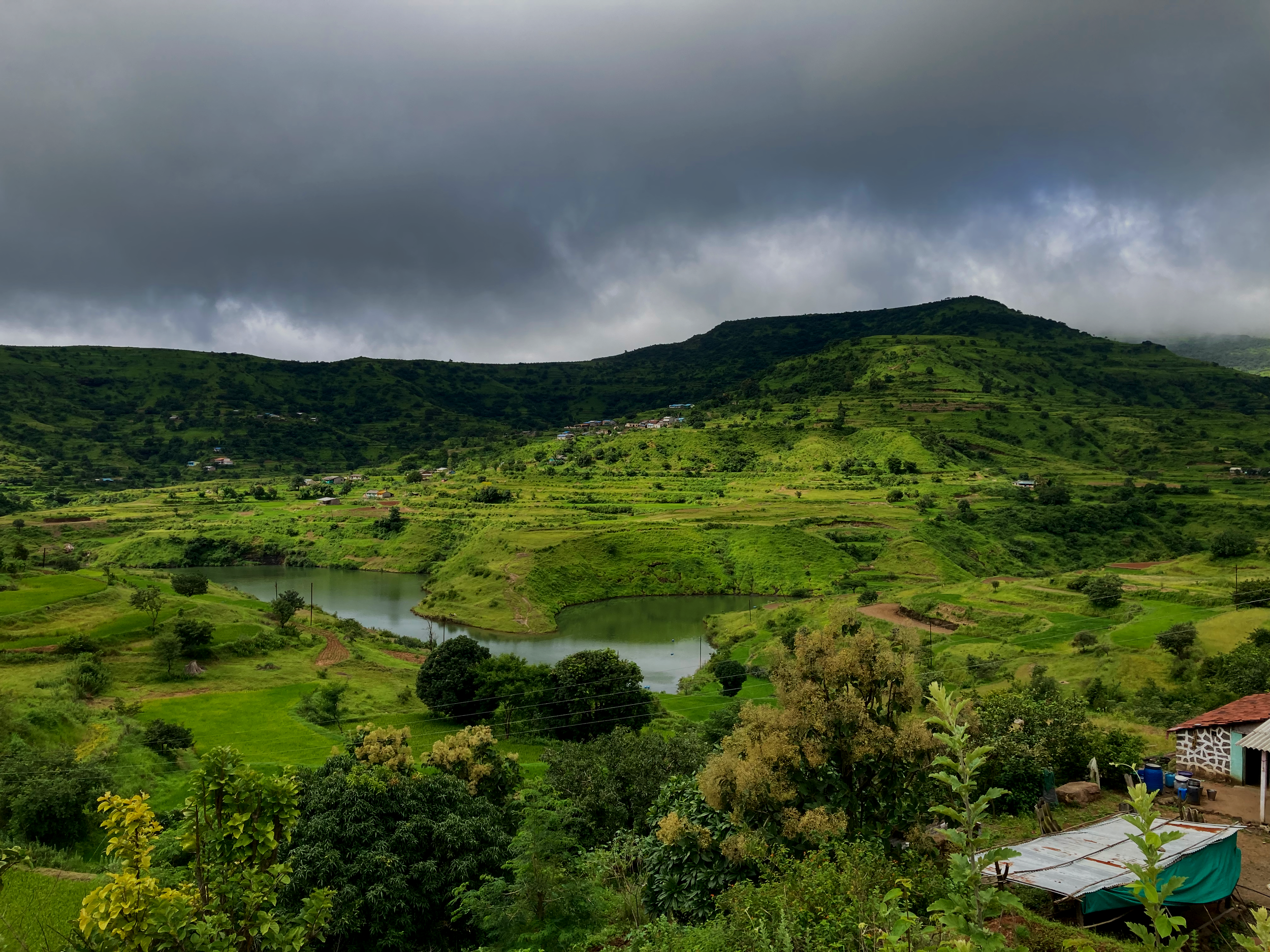
We are building long-term ecological monitoring systems for the Western Ghats and urban India, combining field observation, scientific instrumentation, and community participation to produce environmental data that remains useful across decades.

SciFire
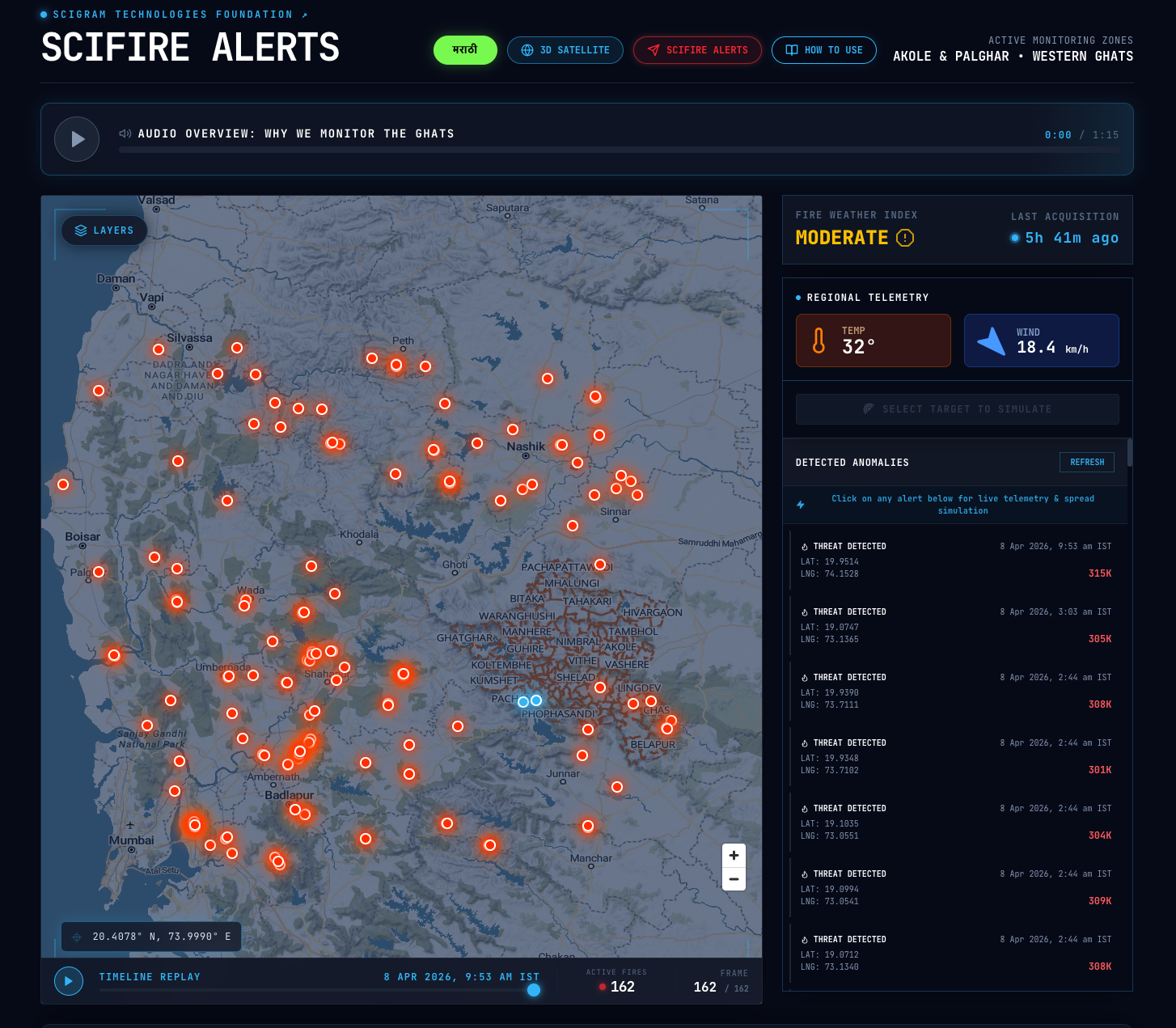
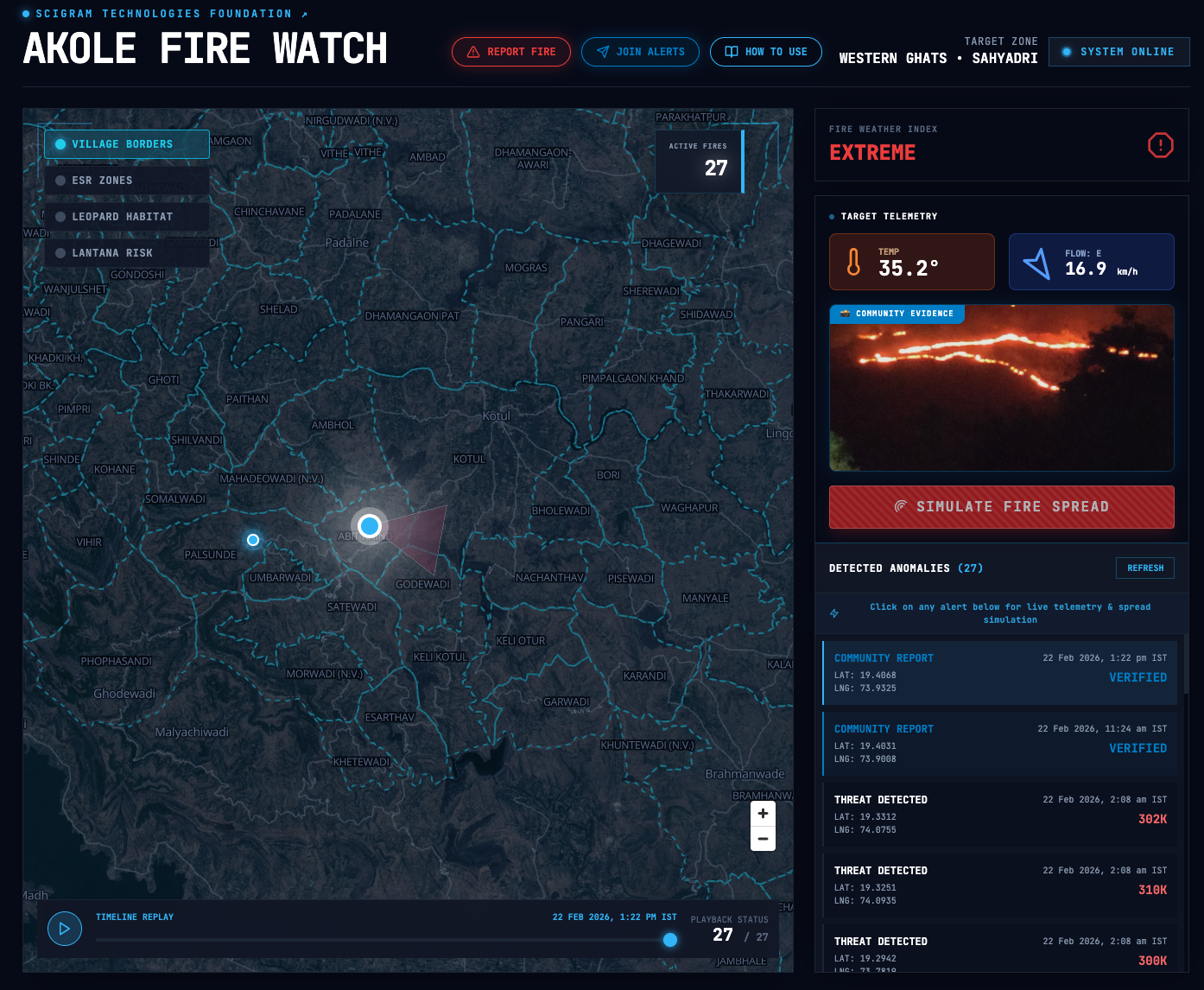
Real-time forest fire monitoring and community alert system for the Western Ghats. SciFire integrates NASA FIRMS satellite hotspot data with citizen-submitted field observations via Telegram, overlays Lantana camara vegetation density as a fire risk amplifier, and runs Rothermel fire spread modelling to estimate danger corridors. Alerts are delivered in Marathi through a three-tier cascade — Telegram, SMS, and IVR voice call — so that communities with low smartphone penetration receive warnings without discrimination. The system is permanently free for all community users. Institutional and research subscriptions support the infrastructure costs.
BONSci
Biodiversity Observation Network Scigram — a structured citizen science programme for indexing flora and fauna across the Western Ghats, anchored at the Palsunde Ashram school as its first node. BONSci trains students and community members in systematic observation protocols and builds a georeferenced, publicly accessible species dataset. The programme is designed to generate biodiversity credits: a verifiable, community-held record of ecological stewardship. These credits are intended to be recognisable by conservation finance instruments over time — creating a pathway for communities to demonstrate and receive value for the biodiversity they protect, without requiring external certification agencies to intermediate that relationship.
AlphaSoil
A long-term community-driven soil health monitoring programme for the Western Ghats, combining citizen field observation with molecular sensing to build longitudinal soil data across ecologically distinct microhabitats. The observatory operates without continuous internet connectivity — data is collected offline in the field and synchronised when connectivity is available. The long-term scientific vision is a soil foundation model for the Western Ghats: a computational layer that connects molecular soil signatures to ecosystem health, agricultural outcomes, and climate resilience. This is among the most technically ambitious programmes Scigram is building, and it is also among the most consequential for the farming and forest communities who depend on understanding what is happening beneath the surface.
Domain 02
Education
We treat education as scientific infrastructure, not content delivery. Students participate directly in observation, experimentation, computation, and long-term field research using the same tools and systems that power Scigram's own scientific work. Every programme is designed to leave durable research and technological capacity within the school community rather than temporary intervention.
Metaknowledger
A node-based science learning platform in which every concept is a pure function and every connection between concepts is function composition. Lean 4 formal verification checks the mathematical and physical consistency of the knowledge graph automatically — so that a student following any learning path encounters only internally consistent science, and so that errors introduced through curriculum drift or translation are caught at the structural level rather than discovered by confused students. Metaknowledger is Scigram's long-horizon answer to what rigorous, self-directed science education looks like when built from first principles rather than adapted from existing curriculum structures. It is also the platform that will eventually host Scigram's own research outputs in a form that students and community members can navigate without requiring a scientific background to enter.
SchoolOS
An offline-first, voice-primary operating layer for government and tribal schools in Maharashtra, designed to address the single most damaging drain on teaching time in under-resourced schools: administrative reporting. SchoolOS works without reliable internet connectivity, uses a Marathi-language voice interface as the primary interaction mode for teachers with low digital literacy, runs AI inference entirely on-device so that no student data leaves the school premises, and automatically generates the administrative reports — UDISE+, POSHAN, health monitoring summaries — that teachers currently fill manually. The architecture is compliant with the Digital Personal Data Protection Act 2023 by structural design, not by policy. No student data is centralised without explicit school-level authorisation. SchoolOS is Scigram's direct response to what the teachers in Palsunde and other partner schools told us was their most urgent need.
Tinkering
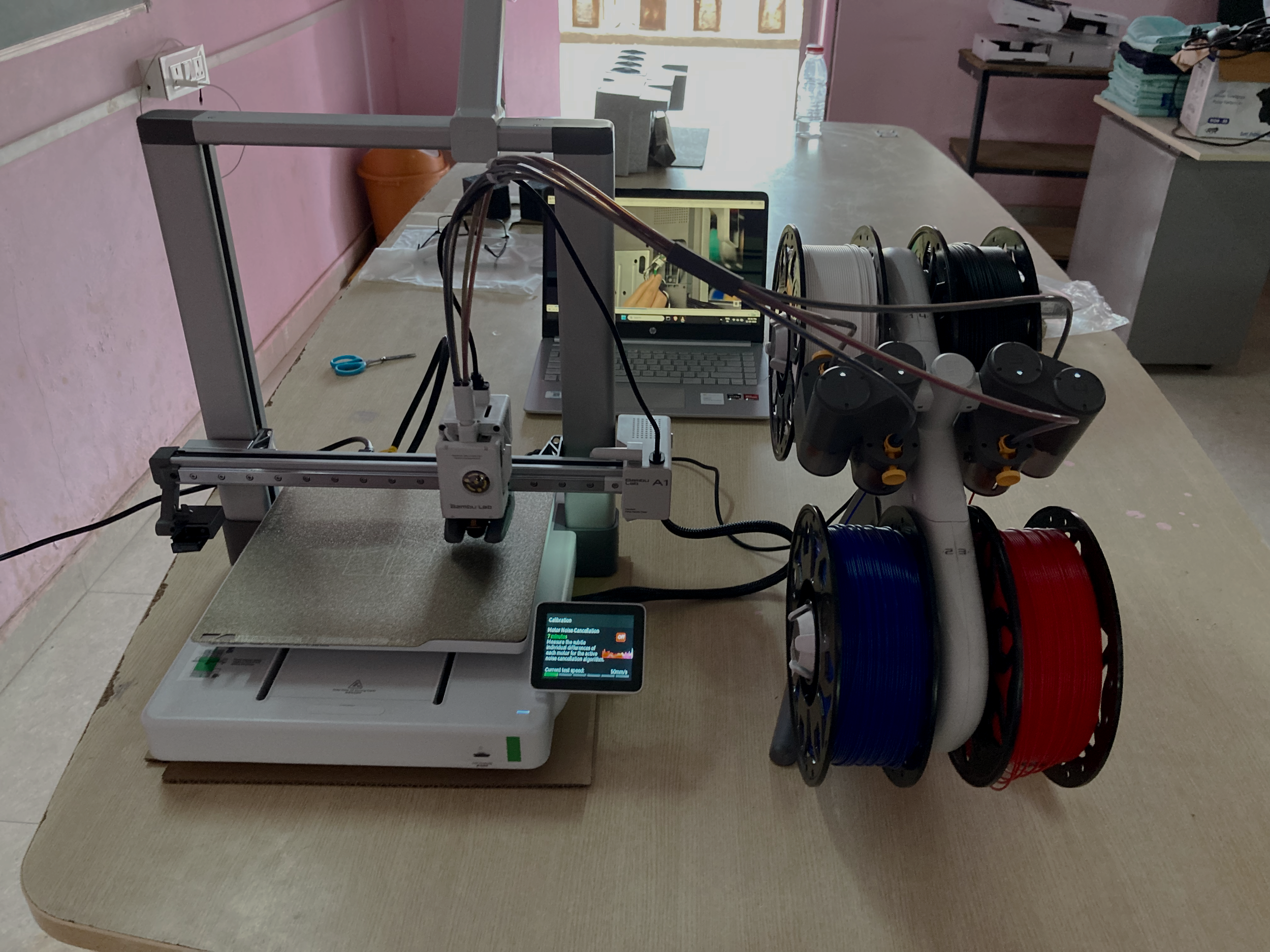
A long-term science education and experimental agriculture programme at tribal Ashram schools in Maharashtra, currently active at Palsunde. The programme runs a formal four-treatment vermicomposting study with students as the research team — they design the experiment, collect and analyse soil health data, and interpret results using the same methods Scigram uses in its Western Ghats research. Students also participate in seasonal biodiversity observation through BONSci, undergo anthropometric health monitoring, and work with sensor-based instruments built in-house at Scigram using 3D printing and Raspberry Pi hardware. The programme is explicitly designed so that its scientific outputs — soil health data, biodiversity observations, student health records — are the same data that Scigram uses in its research programmes, making Ashram school students genuine co-contributors to Scigram's science.
Domain 03
Health
We are building health systems that combine scientific measurement, computational tools, and community participation to address real-world health challenges in underserved environments. Our work includes longitudinal health monitoring, nutrition analysis, AI-assisted diagnostics, and evidence-driven health communication systems designed for real social and infrastructural conditions.
Anemia
Anaemia affects a disproportionate share of children in tribal Maharashtra, yet it remains systematically undercounted in the communities where Scigram works — not because it is undetected, but because the data rarely travels from the point of screening to any place where it can inform policy or resource allocation. Scigram's anaemia screening programme runs non-invasive haemoglobin measurement alongside its existing anthropometric health monitoring in partner Ashram schools, currently covering approximately 400 students across Palsunde and associated schools.
Nutrition
A longitudinal health monitoring programme across Scigram's partner Ashram schools, currently covering approximately 400 students. The programme tracks height, weight, mid-upper arm circumference, and haemoglobin levels, calculates basal metabolic rate using Schofield equations and revised Harris-Benedict equations with Indian population correction factors, and screens for anaemia. The dataset is built for a federated learning architecture as coverage grows — allowing population-level nutritional insights to be generated across multiple schools without centralising sensitive student health records. Findings are shared with school administrators and local health authorities as actionable nutrition reports, and feed directly into the meal planning and agricultural decisions of the partner schools' kitchen and farming programmes.
Tobacco Face
A health communication programme developed with SEARCH NGO for deployment in tribal schools and community health outreach in Gadchiroli district. Tobacco Face uses medically grounded AI-generated imagery to show individuals the concrete biological outcomes of tobacco use across four conditions: accelerated skin ageing, oral submucous fibrosis (OSMF), oral cancer, and post-surgical disfigurement. The approach is rooted in evidence that visual, personalised consequence communication is more effective than generic warning messaging for school-age populations — particularly in communities where tobacco use is culturally embedded and where health literacy does not yet extend to the written language of standard warning labels. The programme was developed through a structured proof-of-concept with SEARCH's medical leadership and is currently in preparation for broader school deployment across Gadchiroli.
Our Impact
5
Ashram Schools
1000
Tribal Students
12
Villages
10
Active Programs
Field Notes


Fund science that stays in the community
Volunteer | Partner with Us | CSR Giving